Every parent who has scrolled a newborn gallery has had the same thought at least once: that cannot be safe. A baby apparently balanced in a basket, hanging in a wrap, or propping its own head on its hands. In a professional studio, those images are not what they seem. They are built from supported poses and, often, two photographs combined in editing. Understanding how they are made helps Huntersville parents choose a photographer with confidence.
Supported, spotted, or composited
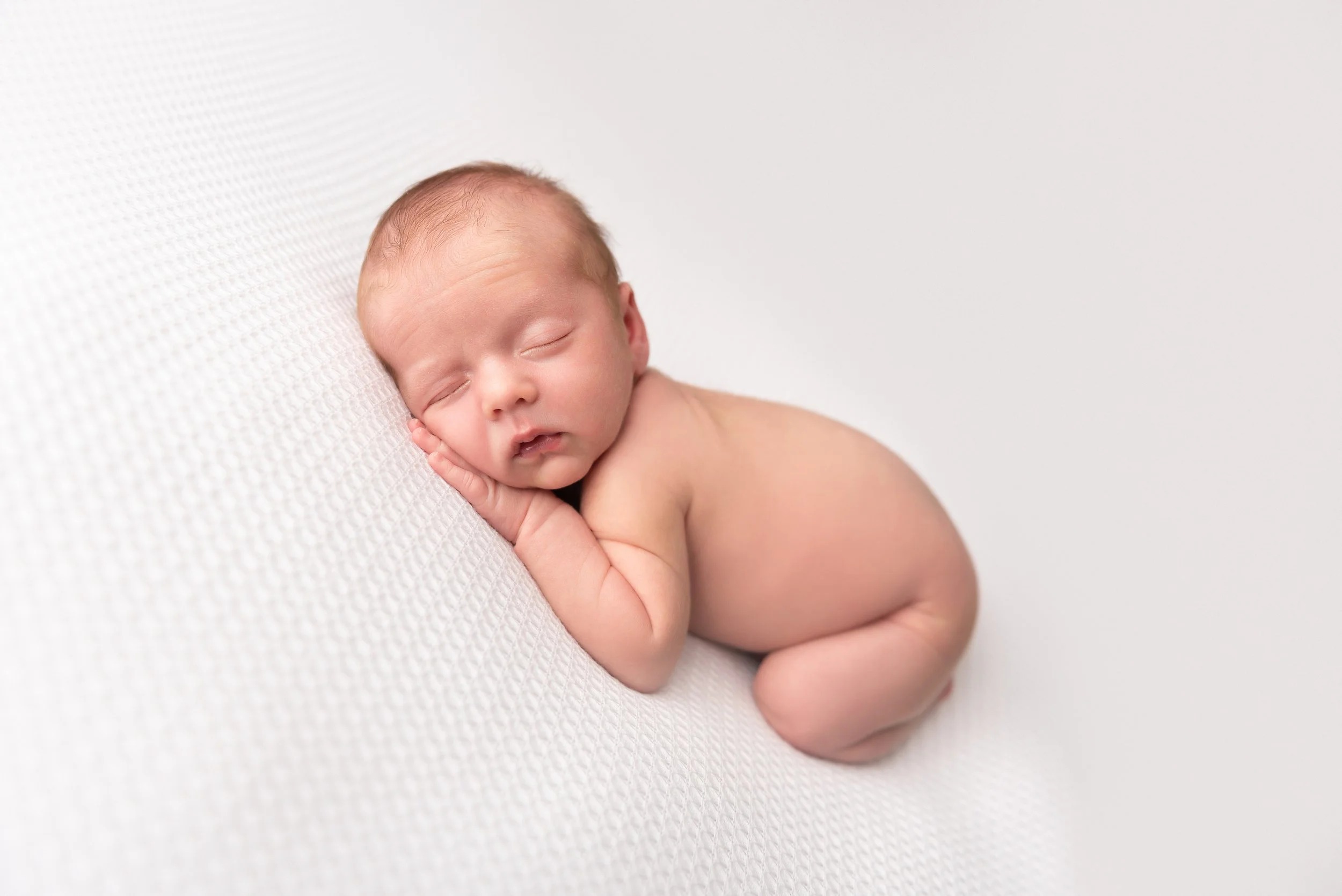
Safe newborn posing falls into three categories. Supported poses use hidden props, rolled blankets, and wedges under the surface so the baby is lying on something solid the whole time. Spotted poses keep an adult's hand on or inches from the baby, with the hand removed in editing. Composites combine two frames, for example one where a parent supports the baby's head and one where they support the body, merged so the baby was never unsupported at all. The famous chin-in-hands pose is the textbook example: a newborn cannot hold that position, and no reputable photographer asks one to.
Temperature, airways, and the unglamorous basics
The poses get the attention, but the real safety work is routine. Studios keep the room warm because posed babies are unclothed, but they also watch for overheating: flushed skin and fussiness are signs to pause. A baby's head and neck are positioned so the airway stays open, never with the chin pressed to the chest. Props are stable, weighted, and padded. Babies are never left alone on a posing surface, even asleep, even for a second, because startle reflexes do not schedule themselves.
Feeding breaks, diaper changes, and settling time are safety measures too. A session that moves at the baby's pace is not just nicer, it is the mechanism that keeps stress low for a days-old infant. Photographers also wash hands, clean props and wraps between clients, and postpone when they are sick, practices worth asking about directly.
Questions to ask any photographer
- How do you create your advanced poses: supported, spotted, or composited?
- Will there be a second adult or a spotter during prop setups?
- What training or mentoring have you had in newborn posing specifically?
- What happens if my baby never settles into deep sleep?
A photographer who works safely, the way dedicated newborn studios in Huntersville do, will answer these questions plainly and without defensiveness. Vague answers, or any suggestion that a baby can simply be placed and balanced, are the real red flags.
The safety work you cannot see in a gallery
Some of the most important safety practice never appears in photographs. Hands are washed or sanitized before handling, and wraps, blankets, and props that touch skin are laundered between babies. Studios that host newborns weekly keep sick-day policies for the photographer, because a mild cold in an adult can be a serious event for a ten-day-old, and sessions are postponed rather than powered through. Floors and posing surfaces are padded in case a parent or photographer stumbles, and nothing is ever set on an unstable surface for the sake of an angle.
Red flags that should end a booking
Trust hesitation when you meet any of these: a photographer who cannot explain how a signature pose is created, who works entirely alone on complex setups without a spotter or parent hands, who resists parents staying in the room, or who dismisses safety questions as overthinking. Also be cautious with anyone offering newborn work as an occasional add-on to an unrelated specialty at a bargain rate, with no dedicated training. Newborn photography is a specialty precisely because the subject cannot protect themselves, and the photographers who treat it that way are the ones to hire.
Common questions
Are hanging or suspended baby photos ever real?
In professional work, no. Those images are composites made with the baby lying on a surface or held throughout, then edited. A baby is never actually suspended.
What if I only want simple, natural photos?
Say so at the consultation. Wrapped portraits, parent-held images, and detail shots involve minimal posing and are a complete session on their own.
Can I stay in the room during the session?
Yes. Parents are present throughout at reputable studios, can watch every setup, and can ask for any pose to be skipped, no explanation needed.
← All guides from Head Over Heels Portrait Photography← Back to Head Over Heels Portrait Photography